Hybrid Pigments for Long-Lasting Color Stability
Hybrid pigments combine organic dyes with inorganic matrices to improve color stability and resistance under harsh environmental conditions. Core-shell nanoparticles further enhance performance by protecting the chromophore from photo-oxidation while enabling tailored optical behavior. In addition, bio-inspired structural color systems based on photonic crystals replace traditional chemical dyes, offering new approaches to long-lasting coloration.
The production of these pigments often relies on sol-gel chemistry or the intercalation of organic molecules into layered double hydroxides, where nanoscale interface control determines color intensity and durability against pollutants. These methods support the creation of archival-quality paints used in conservation. Several commercial hybrid pigment systems are now applied in art restoration, effectively reviving traditional crafts in modern times by bridging historical authenticity with modern material performance.
3D Printed Ceramics
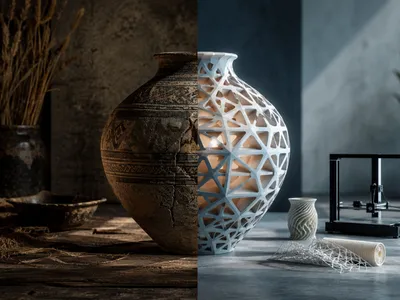
Three-dimensional printing with ceramic materials enables the creation of complex internal channel structures that reduce weight while maintaining mechanical strength. Techniques such as binder jetting, which applies a liquid binder onto powder layers, produce highly porous ceramic objects after sintering. Unlike traditional slip casting, digital fabrication removes the need for molds, minimizes material waste, and allows designers to vary wall thickness to control light transmission and load distribution. Software tools also simulate firing shrinkage, improving accuracy in predicting final dimensions.
Advanced ceramic printing systems further allow the combination of multiple clay bodies within a single object by switching extruder heads or using multimaterial nozzles. This enables the creation of unique visual effects and variable firing temperatures across one piece, including smooth transitions from porcelain to stoneware. As a result, artists can achieve highly customized structural and aesthetic outcomes, exploring what makes a craft truly timeless through methods not possible with conventional ceramic production.
Self-Healing Plasters
Modern self-healing plasters use microcapsules containing healing agents that are released when cracks occur, allowing the material to automatically repair damaged zones. The healing process typically produces calcium carbonate crystals that seal fissures, extending the durability of frescoes and stuccowork. Some advanced systems also include vascular networks that continuously deliver healing compounds to stressed regions over long periods.
Another approach relies on bacterial spores that activate in the presence of moisture and nutrients, triggering calcite precipitation for structural repair. Experimental results show that these plasters can regain up to sixty percent of their original mechanical strength after cracking, making them especially useful for outdoor murals exposed to temperature changes and humidity variations.
| Healing Mechanism | Trigger | Application in Art |
|---|---|---|
| Microencapsulated sodium silicate | Crack propagation | Wall paintings in Mediterranean climates |
| Fungal spore-calcite precipitation | Water infiltration | Underground tomb conservation |
| Shape-memory polymer filaments | Heat above 40°C | Modern plaster reliefs |
Electrospinning in Textile Art Conservation
Electrospinning produces ultra-fine polymer fibers with diameters below one micron, forming nonwoven mats that closely resemble natural textile structures such as silk or wool. In conservation, these materials are used as support layers for fragile and fragmented historical fabrics, providing gentle stabilization without damaging original threads.
One major benefit is the ability to tune fiber composition for specific needs. For example, blending polymers like polyvinyl butyral with polyethylene glycol yields patches that are both flexible and stable. Additionally, electrospinning can embed antioxidants or UV absorbers directly into the fiber matrix, enhancing long-term resistance to photodegradation.
Advanced approaches such as coaxial electrospinning create core-shell fiber structures capable of slowly releasing protective agents over long periods. The outer shell protects the active core from humidity and environmental stress while still maintaining breathability, which reduces the need for frequent conservation interventions on delicate textiles like tapestries and embroideries.
Another important development is fiber alignment to replicate original weave patterns in damaged textiles. By adjusting collector rotation speed and electric field geometry, researchers can form anisotropic mats with directional mechanical behavior similar to woven fabric. This allows patches to preserve drape and flexibility, while the room-temperature process avoids heat damage and has been successfully applied to stabilize historical silk garments and ancient cotton fragments.
Responsive Materials and Interactive Art
Thermochromic pigments change color reversibly with temperature fluctuations. Artists embed these materials into paintings that shift appearance when viewers approach.
Piezoelectric polymers generate electrical signals under mechanical stress. Integrating them into sculptures allows the artwork to respond to touch or ambient vibrations through light or sound.
A growing class of interactive artworks uses hydrogels that swell or contract in response to humidity changes. These materials create dynamic textures that alter the piece's surface topography over hours or days. Another approach employs electroactive polymers that bend when a voltage is applied, enabling slow, organic movements in wall-mounted installations. Unlike motorized kinetics, these responsive materials operate silently and consume minimal energy.
| Responsive Material | Stimulus | Artistic Application |
|---|---|---|
| Thermochromic leuco dyes | Temperature (25-35°C) | Interactive portraits that reveal hidden layers |
| Piezoelectric PVDF film | Mechanical pressure | Sound-emitting floor installations |
| Humidity-responsive silk fibroin | Relative humidity (40-80%) | Self-adjusting textile screens |
| Electrochromic tungsten oxide | Low voltage (2-5 V) | Color-switching glass panels |
Durability remains a central challenge for responsive art materials. Repeated cycling of thermochromic pigments leads to fatigue and loss of color intensity after several thousand cycles. Researchers now encapsulate these pigments in UV-blocking polymer shells to extend their operational lifetime. Similarly, hydrogels require careful sealing to prevent dehydration or biological contamination. Despite these hurdles, museums have begun reviving traditional crafts in modern times by commissioning small-scale responsive works for temporary exhibitions, gathering valuable data on long-term performance under real gallery conditions. The integration of wireless power transmission and miniaturized control electronics further expands the possibilities, allowing artworks to react not only to environmental changes but also to remote audience inputs via smartphone applications.